
14-Year-Old Wins $25,000 for Origami-Inspired Structure That Holds 10,000 Times Its Weight
- Layana Mary
- Dec 2, 2025
- 2 min read

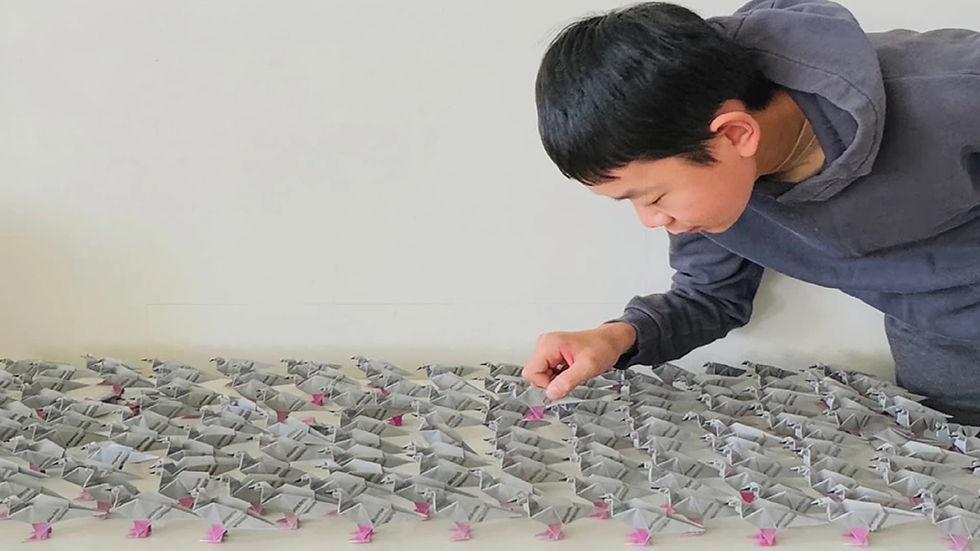
A 14-year-old student has captured global attention by winning a prestigious $25,000 STEM award for designing an origami-inspired structure capable of supporting 10,000 times its own weight. This groundbreaking innovation has the potential to transform fields ranging from space exploration to disaster-relief engineering and sustainable transport systems.
From Art to High-Impact Science
The project reimagines traditional Japanese origami folds, creating a geometric design that combines flexibility with remarkable strength. Using minimal material, the structure achieves maximum load-bearing capacity, making it one of the most efficient and innovative structural models ever created by someone so young.
Experts say the applications of such a design are vast and impactful:
Space Technology: Ultra-lightweight spacecraft components where minimizing weight is critical.
Disaster Relief: Deployable shelters that are easy to transport and can withstand extreme conditions.
Robotics: Particularly in soft robotics where flexible, durable structures are essential.
Sustainable Packaging: Eco-friendly packaging solutions that maximize strength while reducing material use.
Recognition and Awards
The $25,000 prize comes from a global STEM competition that celebrates teenagers who leverage science and engineering to address real-world challenges. Judges lauded the project for its "rare combination of elegance, originality, and engineering relevance," emphasizing how the structure bridges artistic creativity and scientific ingenuity.
How the Structure Works
The unique fold pattern redistributes stress across multiple ridges, allowing the structure to:
Compress without breaking
Expand without tearing
Withstand extreme forces while remaining ultra-light
The student validated the model through rigorous physical stress tests and digital simulations, consistently demonstrating that the structure could handle thousands of times its own weight without damage.
Why This Matters
Origami-inspired research has historically driven innovations at NASA, MIT, and top robotics labs, often developed by adults in their 20s or 30s. The achievement by a 14-year-old underscores the accelerating impact of young minds in STEM fields, especially those supported by hands-on innovation platforms.
A Teen Scientist to Watch
The young inventor hopes to further refine the model for practical applications. “I wanted to show how art and science can come together to solve real problems,” the student said.
This recognition places the teen among a growing generation of young STEM leaders who are reshaping technology, biomedical devices, and climate solutions with inventive, cross-disciplinary approaches.


Comments